Marketing for Tradespeople in South Tyrol: What Really Brings Customers?
Reviewed by Jonas Tribus
Short answer
What genuinely brings enquiries to a trades business in South Tyrol: flyers, Google Ads or referrals? Real search data from South Tyrol and Trentino shows where demand already exists and why only one form of visibility continues to belong to the business.
The essentials at a glance
For a trade business in South Tyrol, the question is simple: which marketing channels actually generate enquiries? What really brings enquiries to a trades business in South Tyrol: flyers, Google Ads or referrals? Real search data from South Tyrol and Trentino shows where the demand is and why only one type of visibility belongs to the company itself.
- Customers first search for trade and construction businesses on Google, on Google Maps and increasingly in AI answers: by “trade plus location”, not by the company name.
- Interrupt (flyers, newspapers, cinema, sponsorship): reaches people with no current need and can hardly be assigned to an enquiry.
- Buy (Google Ads, trades platforms): collects existing demand immediately, but only works as long as the budget runs.
- Own (Google Business Profile, website with genuinely useful answers, Outside Mentions): remains as long as it is maintained.
- In South Tyrol this visibility must be bilingual: searches are carried out in German and Italian.
- Success is measured in enquiries, not in clicks, verifiable in 90 days.
This article is based on: Search data for South Tyrol and Trentino (Ahrefs, September 2, 2026) and Google Search Console data from Bauexpert, June to August 2026.
The real problem: more qualified enquiries, and no one knows where today's ones are coming from
Many established trade and construction businesses in South Tyrol with 10 to 50 employees do not have an acute order problem today. What they are missing is something else: a reliable route to more qualified enquiries, enquiries from builders who have a specific project and don't yet know the company.
For many of these companies, orders come from referrals, from the architect you have known for years, from the neighbor of the last customer. This works as long as it works. But ask yourself honestly: If a builder in Bolzano, Merano or Brixen doesn't know anyone who knows you: how does he find you?
And the second question, which rarely anyone can answer in our conversations with companies: Where exactly did the last ten enquiries come from? Not “mainly referrals”, but specific. Which via Google, which via Maps, which via the website, which via the vehicle branding?
If you don't know this, you can't know what marketing burns money. This creates the typical mix of flyers, newspaper advertisements, sponsorship and a few hundred euros in Google Ads, without any evidence as to which of these brought in more orders.
The way out doesn't start with a new channel. It starts with the question: Where are our customers actually looking today?
Where your customers in South Tyrol are really looking: Google, Google Maps and increasingly ChatGPT
The answer is uncomfortably simple: A large proportion of your future customers search on Google: for the trade and the location, not for a company name. This can be proven with figures for South Tyrol.
“Elektriker Bozen”, “elettricista Bolzano”: the demand is already there, in German and Italian
How many people in South Tyrol actually look for a trades business before calling someone? That can be measured.
In South Tyrol, trades businesses are regularly searched for using “trade plus location”. According to Ahrefs (search data for Italy, as of September 2, 2026), there are around 150 searches per month for “idraulico Bolzano”, around 100 for “electrician Bolzano” and around 30 each for “impresa edile Bolzano”, “construction company South Tyrol” and “construction company South Tyrol”. According to Ahrefs, for all of these searches, Google shows a map box with three establishments at the top, the so-called Local Pack. Companies that are not there will only be found by luck by this customer at this moment.
These are people with a specific need who are looking for a business right now, not random readers of a newspaper ad. For a single trade in a limited local market, these search queries show specific needs. However, they cannot be equated with enquiries or orders: a search only becomes an enquiry when the company is visible, selected and convincing.
The picture becomes even clearer when you look at the data from a real company.
Example from a RankProfi customer: Bauexpert, a building materials and construction specialist trading company with 16 locations in South Tyrol and Trentino. Between June and August 2026 alone, Bauexpert's website was displayed around 15,000 times in searches in which the company name did not appear. Instead, people searched by product or service plus location: “Baumarkt Brixen” (182 impressions), “ferramenta Brunico” (302), “hardware store nearby” (427), “materiali edili vicino a me” (130), “Roofer South Tyrol” (67), “Velux roof window South Tyrol” (140). After a rough classification of the search terms by language, about half of these searches were in Italian and about a quarter in German; the rest could not be clearly assigned.
Source: Google Search Console from Bauexpert, June 1st to August 31st, 2026, search queries without brand terms, top 1,500 search terms. Language distribution: own estimate, not Google analysis. Bauexpert is not a trades business; the numbers show search behavior in the construction industry, not the enquiries for a trades business.
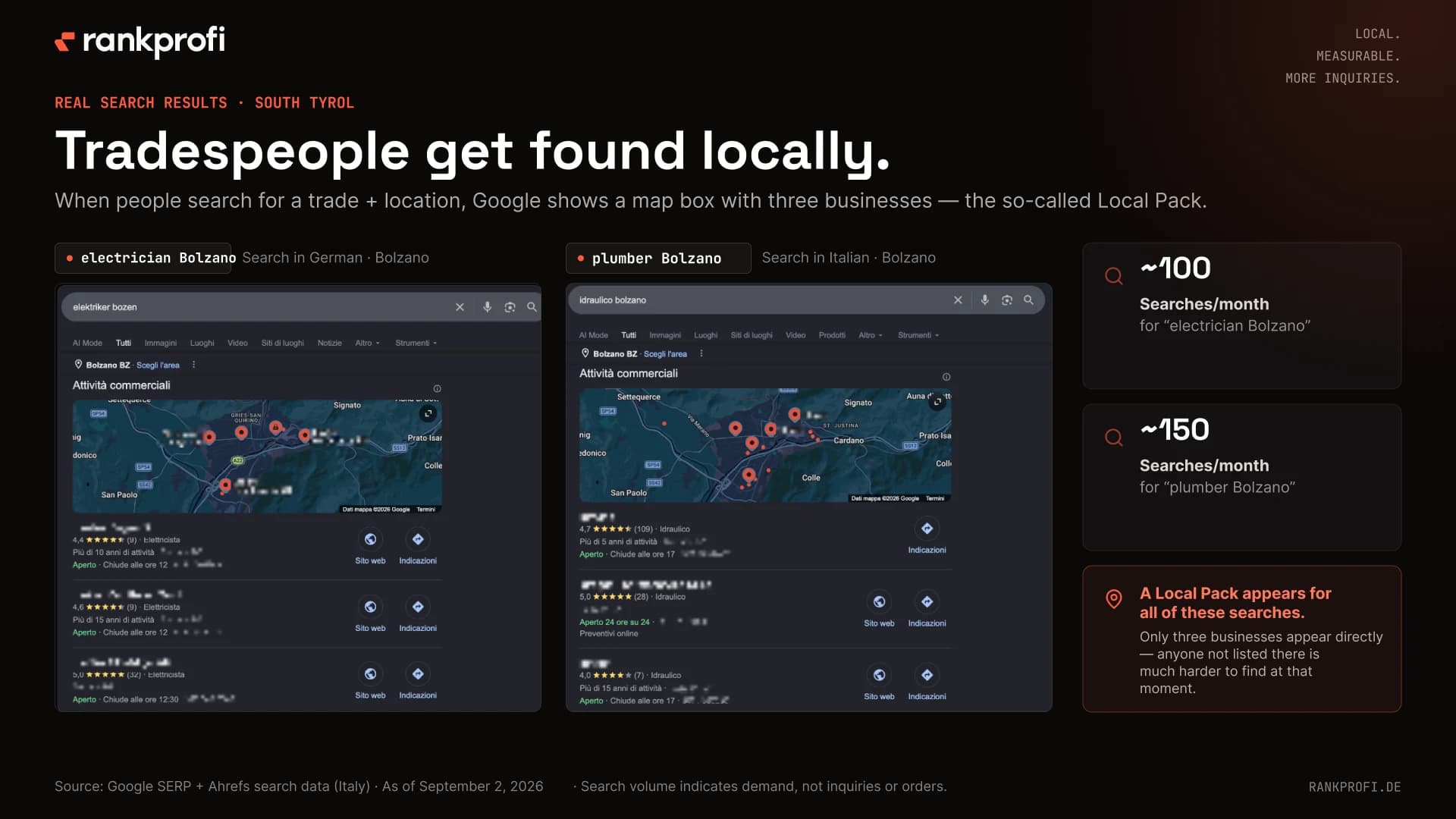
Visual source: Google SERP snapshot and Ahrefs keyword-volume data for Italy, 2 September 2026—not Google Search Console.
What does that mean for a trades business? Three things.
First, demand exists before you spend a dime on marketing. No one needs to be convinced that they need a roofer. They are already looking.
Second: People are looking for the trade and the location, not for a brand. Anyone who is only found under their company name is invisible to all of these searches.
Third: In South Tyrol, a large proportion of customers search in Italian. A business that is only visible in German can be invisible to a significant portion of its catchment area and often doesn't realize it because these searches don't appear in any statistics it sees.
Who is named when someone asks the AI about a business in Merano?
More and more people are no longer asking their question in the Google search bar, but rather in an AI: “Which construction company in Merano is recommended?” or “Who does good interior design in South Tyrol?” Google itself now answers many searches with an AI answer before the normal results come. These AI Overviews noticeably change the first Google page.
AI answers name specific companies and link to sources. The providers do not disclose which rules apply to a company. What is observable: Companies are mentioned about which there is clear, consistent information on the internet that has been confirmed by third parties.
We have disclosed that a company from South Tyrol can appear in these answers how we measure AI visibility.
Example: Bauexpert in AI answers. In September 2026, Bauexpert will appear in 40 measured AI answers; 33 pages of the website are named there as sources. The answers are spread across Google AI Mode (22), Google AI Overviews (6 answers, 11 pages), Perplexity (4), ChatGPT (3), Copilot (3) and Gemini (2). According to internal observation, the company had virtually no measurable visibility in these formats a few months ago; There is no reliable comparative figure.
Source: Ahrefs AI visibility measurement as of September 2, 2026. Snapshot, no growth rate, no statement as to whether the AI recommends the company.
What does this mean for a trades business? AI answers are another place where customers may or may not find businesses. What's striking is where most of these answers come from: 28 out of 40 come from Google's own AI formats. This suggests that a company that is well positioned at Google also has better conditions when it comes to AI answers. It's not an automatic thing.
Four ways to generate enquiries—and why only one belongs to you
Every marketing channel can be examined with the same three questions:
- Does it bring enquiries from people who are currently looking for a business?
- Will it continue to work if I stop paying?
- Can I prove where each enquiry came from?
With these three questions, the marketing of a trades business almost sorts itself out.
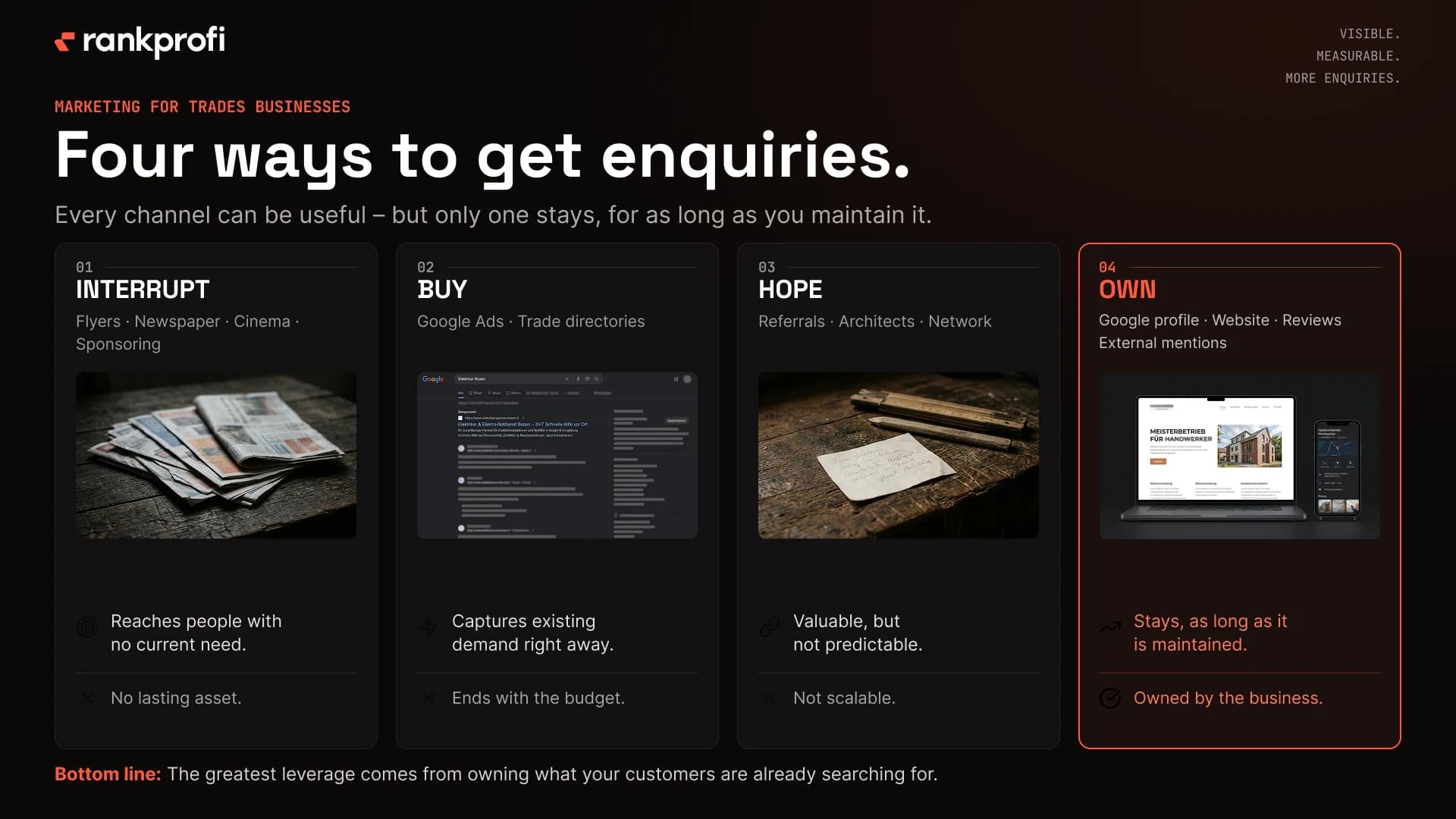
Interrupt: flyers, newspapers, cinema, sponsorship and vehicle branding—good for awareness, weak for enquiries
These channels reach people who don't need anything from you at that moment. The flyer ends up in the trash, the advert is scrolled through, the cinema spot plays while the viewer thinks about the film.
That doesn't mean that these measures are worthless. The lettering on the company car makes your name known in the village. Sponsoring the band is part of anchoring it in the town. But their contribution to new enquiries can hardly be proven in practice. Hardly any company can say which order originated from the flyer. They are image maintenance. Anyone who counts it as customer acquisition cannot honestly evaluate their marketing.
Buy: Google Ads and trades platforms—capture demand immediately, with ongoing costs
Google Ads immediately shows your company at the top when someone searches for “electrician Bolzano” for a fee per click. That's the big advantage: Google Ads picks up existing demand without waiting time. For a new service, a new location, a seasonal campaign or a lull in orders, this is often the quickest way to get enquiries.
The price for this is ongoing advertising expenditure: visibility exists as long as the budget runs. Google Ads doesn't build visibility that lasts. That's not his job either. Anyone who uses Google Ads should have a fixed monthly budget, accurately measure which enquiries came through the ad, and regularly check whether the costs per enquiry are worth it.
Trades platforms work in a similar way: They deliver enquiries for a fee or commission, often to several companies at the same time, so that price becomes the main argument. They can help with capacity utilization in weak phases; They do not build a lead over competitors.
Google Ads is not an opponent of your own visibility, but rather a complement to it. Below is how the two interact.
Hope: referrals are valuable, but they are not a system
Referrals are the most valuable channel for many trades businesses: a referred prospect already brings trust and the price is rarely the focus.
The problem is not the referral. The problem is dependence on it. Referrals cannot be planned, scaled or controlled. In good years they are enough. In a weak year, at a new location or when the architect retires, the pipeline suddenly dries up.
And: Even recommended customers usually google the company before calling. What they find or don't find determines what they do.
Own: be visible where demand already exists
The fourth way is the one that many companies use least consciously: be present where customers are already looking. For “Electrician Bozen” the first three card hits say: this is local visibility. For “Baufirma Meran” on the first page. Be mentioned in the AI response when someone asks about a business in your catchment area.
This visibility is yours. It doesn't end with the monthly budget, but continues as long as your profile, website and reviews are maintained, even at night, on weekends and during peak seasons when you don't have time for marketing. It is not guaranteed and positions may shift. But it can be built, even for an established company that has so far only been found under its name.
Bauexpert shows what such a development looks like in numbers, again as an example of visibility in the construction industry, not for enquiries from a trades business.
Example: Bauexpert, visibility for searches without company name, June to August compared to March to May 2026. “Velux roof window South Tyrol” went from 8 to 140 impressions, position 14.5 to 10.3, clicks 0 to 4. “ferramenta Bressanone” from 109 to 150 impressions, position 9.5 to 5.5. “ferramenta Brunico” from 130 to 302 impressions, position 8.4 to 8.1, clicks 1 to 3. “Roofers South Tyrol” from 6 to 67 impressions, position 22.2 to 13.6. “ferramenta Trento” from 41 to 77 impressions, position 5.2 to 3.3.
Overall, the Bauexpert website was displayed around 28 percent more frequently in searches without a company name in the summer of 2026 than in the spring (11,785 to 15,064 impressions). The Ahrefs ranking data shows the same direction: “materiali edili Trento” from 12th place to 5th, “materiali edili Bolzano” from 8th to 5th, “Baumarkt Bruneck” from 5th to 3rd.
Source: Google Search Console from Bauexpert, June 1 to August 31, 2026 versus March 1 to May 31, 2026; Ahrefs ranking changes, as of September 2, 2026. These are visibility values, not enquiry or order numbers. Overall, clicks from searches without company names remained almost unchanged over the same period.
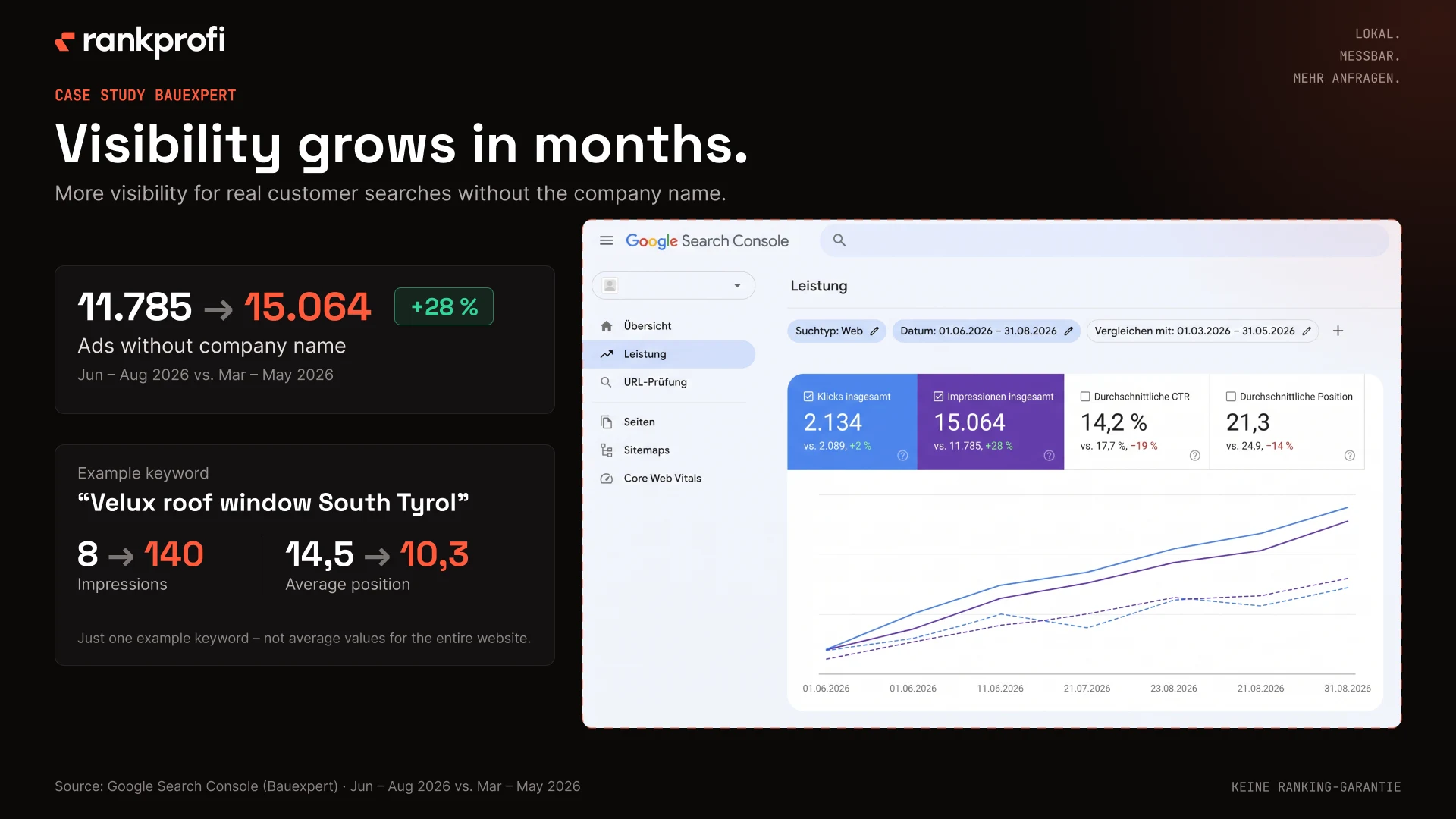
What does that mean for a trades business? Visibility for real customer searches, service plus location, in German and Italian, can be measurably expanded for an established company. It changes in months, not days. And it is the first step in a chain: search, visibility, click, enquiry, customer. The numbers above represent the first two links in this chain. Without it, the query from the search doesn't even exist.
What your own visibility consists of, without any technical jargon
Visibility on Google, on Google Maps and in AI answers does not come from a trick. It happens when four things fit together.
A Google business profile that customers trust
The Google Business Profile is the listing that customers see on Google Maps and next to search results, with reviews, photos, opening hours and phone number. When searching for “trade plus location”, this profile is often the first thing a customer sees of a trades business, even before the website. How the order on the map is created and what a company can actually do can be found in the article Google Maps for tradespeople.
A profile that customers trust has: the right categories (not just “construction companies”, but what you actually do), current photos of real construction sites and the team, a description in German and Italian, regular new reviews and answers to them, even the critical ones. Anyone who actively asks for an evaluation after each completed project builds up a portfolio over time that a competitor cannot catch up on in just a few weeks.
A website that answers the customer's question, not just a digital business card
Many craftsman websites are brochures: home page, “About us”, “Services”, “Contact”. You don't answer the customer's question. This is also the reason why a lot of what is sold as “online marketing for trades businesses” comes to nothing: it sends visitors to a page that doesn’t help them.
The customer asks: Does this company do roof renovations in my area? How much does it cost approximately? How long does it take? Can I see pictures of similar projects? How do I contact him and does he respond?
A website that brings enquiries has a separate page for each important service that answers these questions, with real project images from South Tyrol, in both languages, and a contact path that works on a mobile phone in ten seconds. This is not a design issue. This is a content topic.
Mentioned by others: LVH, suppliers, press, satisfied customers
External mentions are seen by Google as a sign of how well-known and established a company is in its region; Google itself names this “prominence” as one of the factors for local ranking, alongside relevance and distance (Google Business Profile Help). The connection for AI answers is not disclosed, but it can be observed: companies that third parties also report on are preferred. An entry in the LVH, a mention on a manufacturer's reference page, a report in the local press about a special project, a customer naming who built it on their own website. Each of these mentions is a voice from outside.
For trades businesses, this is often the most underestimated component. The mentions are usually already there: suppliers, partners, completed projects. They were just never collected.
The same facts about your business everywhere so Google and AI understand who you are
Company name, address, telephone number, opening times, services, catchment area: This information must be identical on the website, in the Google profile, at LVH, in business directories and in social networks, in both languages.
That sounds banal, but in our work it is one of the most common reasons why companies are found worse than they deserve. If there are five slightly different versions of the same business in five places (different name, old address, second phone number), it is not clear to Google and AI systems whether they are the same business. This question does not arise with the competitor where everything is the same.
Special case: construction companies and companies with multiple locations
Marketing for construction companies with two, three or more locations, headquarters, warehouse, exhibition, second branch, has this problem several times. Each location needs its own complete Google profile and page on the website. If this is missing, Google can show the headquarters in Bolzano for “construction company Brixen” or a competitor that can clearly be found in Brixen.
Bauexpert has 16 locations in two provinces and two languages. The company is now displayed on the first page for location searches such as “ferramenta Bressanone” (position 5.5) or “Baumarkt Bruneck” (position 3) (Google Search Console June to August 2026, Ahrefs September 2026). In our opinion, it is essential that each location is clearly recognizable as a separate place for Google. The same logic applies to a trades business with two locations, only more manageable.
This has a name: SEO and GEO
Everything that has been said in this article so far about your own visibility has two names in the professional world. You don't have to like them, but you should know them because you will encounter them at every agency.
SEO (Search Engine Optimization) refers to the work with which a trades business becomes visible to its customers in Google searches and on Google Maps and becomes competitive against competitors. For an electrical company in Bolzano, SEO means: being high up in the search results and in the map box for “Electricians Bozen”.
GEO (Generative Engine Optimization) refers to the work with which a trades business becomes understandable and credible for AI systems such as ChatGPT, Google AI Mode or Perplexity so that it appears in AI-generated answers. We have written down exactly where the difference between SEO and GEO lies. For a construction company in Merano, GEO means being mentioned when someone asks the AI which construction company in Merano is recommended.
SEO and GEO together result in visibility that belongs to the business: presence in the places where customers search, today on Google and Maps, increasingly in AI answers. This visibility does not expire with the monthly budget, but can continue to grow with every project, every review and every mention, provided it is maintained.
SEO and GEO are not two separate construction sites. This is what SEO and GEO for trade and construction businesses looks like in practice. A complete Google profile, a website with real answers, outside mentions, and the same facts everywhere provide the foundation for both. The Bauexpert example shows both sides of the same company: more visibility on Google for location searches and at the same time presence in 40 measured AI answers, 28 of them in Google's own AI formats (Ahrefs, September 2026). Whether one triggered the other cannot be deduced from the data, but both are on the same basis.
Google Ads plus SEO plus GEO: Pick up demand today, build visibility for tomorrow
The strongest lineup for an established business is usually not an either/or decision. Google Ads and your own visibility have different tasks.
Effect. Google Ads takes effect immediately as soon as the campaign runs. SEO and GEO build up over months.
Costs. Google Ads incurs ongoing advertising costs per click. SEO and GEO require setup and maintenance work, but no costs per click.
If you stop. With Google Ads, visibility ends with budget. With SEO and GEO it stays as long as it is maintained.
What is it suitable for? Google Ads for campaigns, new services, new locations and fast utilization. SEO and GEO for long-term discoverability on Google, on Maps and in AI answers.
Google Ads captures the demand that is there today. SEO and GEO build the visibility that will still be there in a year and that makes AI answers possible in the first place, because there are no ad spaces to buy there. Anyone who combines the two will now receive enquiries and at the same time become less dependent on the ongoing advertising budget.
RankProfi focuses on SEO and GEO. If requested, our partner Alpin Ads can take care of paid campaigns so that both work in harmony.
What it realistically costs: time, money, patience
Honesty at this point saves disappointment later.
Time. Visibility on Google changes in months, not weeks. The example above shows movements comparing two quarters; In our experience, stable positions for the most important searches take longer, and the process depends on the starting point, local competition and maintenance. Nobody can seriously promise fixed deadlines. Anyone who promises results in four weeks is promising too much.
Money. Most established businesses already spend money on marketing, on newspapers, sponsorships, advertisements, printed matter. The question is rarely whether more money is needed, but rather whether what is available is going to the right places. If you reallocate part of your budget from interruptive marketing to your own visibility and use Google Ads specifically instead of permanently, you are working with the same money on something that will last beyond the end of the month. What exactly it costs to build your own visibility can be found below in the section on agency decisions.
Patience. The setup is the hardest at the beginning: cleaning up profiles, writing pages, collecting mentions, triggering reviews. After that it gets easier because every project, every assessment and every report builds on what is already there.
How you'll know in 90 days if it's working: Enquiries count, not clicks
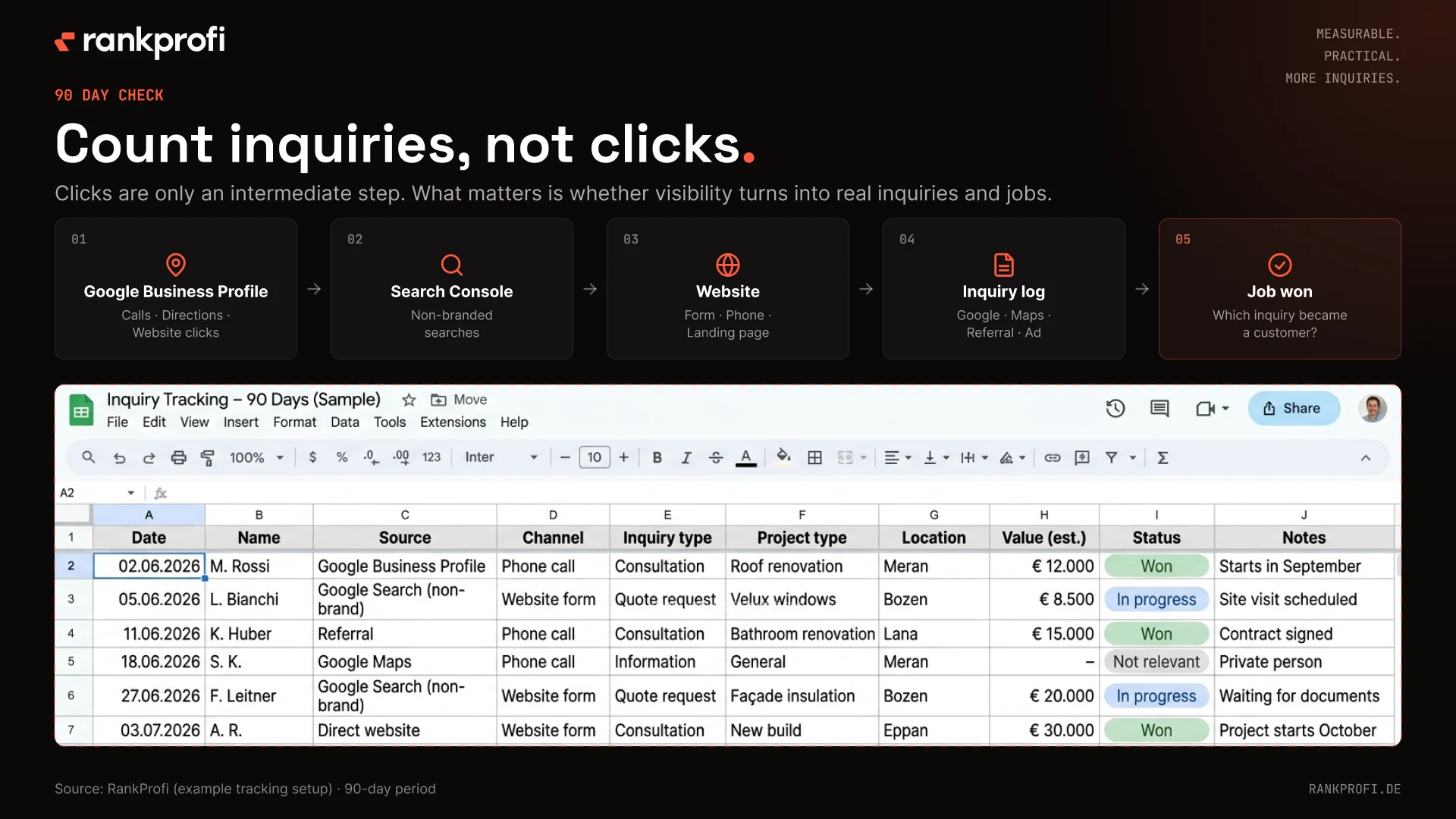
The most important step costs nothing and takes an hour: Starting today, keep a list in which every enquiry is entered with its origin. Referral, Google, Maps, website, portal, ad, vehicle, “don’t know”. Ask each caller, “How did you find out about us?”
After 90 days, you will know for the first time where your enquiries are coming from and what you can delete.
There are three measurements that Google provides you free of charge:
- In Google business profile: Calls, route enquiries and website clicks per month. Do they rise? Google explains these values in Performance and Statistics Help.
- In Google Search Console, Google's free tool for your website: How often does your website appear in searches that do not contain your company name? This is exactly the value that rose from 11,785 to 15,064 in the Bauexpert example.
- On your website: How many enquiries came from the contact form or phone number on the website?
Count enquiries, not clicks. Clicks are an intermediate step. Enquiries are the goal.
Do it yourself or hire a marketing agency for trades businesses? When each option makes sense and what to ask
A trades business can do a lot of things from this article themselves: complete the Google profile, ask for reviews, keep the enquiry list, ask suppliers and partners to be mentioned. This takes time, not money, and it is definitely the right first step.
It becomes more difficult when it comes to the website in two languages, when it comes to the question of which searches are actually worth setting up, when it comes to systematically collecting mentions and when it comes to the question of how AI systems see your company today. Here, many companies reach the limits of what is possible outside of their day-to-day business.
When vetting an agency, ask these five questions:
- Show me search data from South Tyrol, not from Germany, in German and in Italian?
- After 90 days, how do we measure whether it's working, in enquiries, not clicks?
- How do you determine whether and how my business appears in AI answers today?
- What exactly do you do with my locations, my Google profile and my reviews?
- What happens to my visibility if we end the collaboration, is it mine?
A marketing agency for trades businesses that has a clear answer to all five questions works towards visibility that is yours. One that primarily talks about reach, clicks and campaigns sells you attention over time. Both can have their place. Just make sure you know what you're buying.
RankProfi is an agency for SEO and GEO based in South Tyrol. We work for companies in the construction, interior design and hotel industries, in German, Italian and English, with search data from South Tyrol and Trentino. The first step is always the same: look at where your company stands today.
What the support costs for your business depends, among other things, on competition, number of locations, condition of the website and the required German and Italian coverage. We name the framework after the free Google and AI visibility analysis.
Free Google & AI visibility analysis for your business
We check how your business is visible on Google, Google Maps and in relevant AI answers, where competitors appear before you and what gaps can be closed in German and Italian.
Frequently asked questions
A trades business wins customers most reliably where people already search for its service: Google Search, Google Maps and increasingly AI answers. In South Tyrol, that means being visible for service-plus-location searches in German and Italian, supported by a complete Google Business Profile, useful service pages, recent reviews and credible third-party mentions.
Google Ads charge per click and provide visibility while the campaign runs. Organic and Maps visibility does not charge per click, but requires sustained work on the profile, website, reviews and mentions. Professional SEO and GEO costs depend on competition, locations, website condition and language coverage.
Construction companies win work through referrals, architects and networks, but increasingly also when clients search for a construction company plus location or ask an AI assistant. Each location needs a complete Business Profile, bilingual service and project pages, and clear enquiry-source tracking.
Yes, if the business wants to reach the full market. In Bauexpert Search Console data, roughly half of non-brand searches were Italian after a manual language classification. A single-language website can therefore miss a substantial share of relevant local demand.
They can. AI providers do not disclose exactly why a business is named, but consistent company facts, useful content and credible third-party mentions give systems clearer evidence. Company size alone is not the deciding factor.
Yes, when enquiries are needed quickly for a new service, location, campaign or quieter period—and when the campaign has a fixed budget and proper enquiry tracking. Ads work best alongside owned SEO and GEO visibility.
Sources
- Google names relevance, distance and prominence as the factors behind local result rankings.Google Business Profile Help · 2026-09-02
- Calls, direction requests and website clicks can be measured in Google Business Profile.Google Business Profile Help · 2026-09-02
- Search Console defines impressions as appearances in results and clicks as visits.Google Search Console Help · 2026-09-02
- South Tyrol service-plus-location search volumes include idraulico Bolzano 150, Elektriker Bozen 100 and impresa edile Bolzano 30 per month.Ahrefs, Italy search data · 2026-09-02