Short answer
Google Maps shows trade businesses in local results above most websites. Google names relevance, distance and prominence as the main factors. What matters in practice: a correct Business Profile, the right primary category and services, an honest service area, consistent bilingual website content, real reviews, and measurement that runs all the way to the enquiry.
The short version
Why does a competitor show up on the map for "elettricista bolzano" and your business does not, when you have been trading longer and have the better references? A sample of real Google results from South Tyrol, collected on 3 September 2026, shows what Google decides on and what a trade business can do with that.
- Customers search for the service and the place, not the company name: "elettricista bolzano" 200 searches a month, "idraulico bolzano" 150, "elektriker bozen" 100.
- In all 17 service-plus-place searches in our sample with Ahrefs data, Google shows a map block with three businesses before the first website.
- Whoever is in it does not automatically have the most reviews. In three of four map blocks, the business at the top was not the one with the most reviews.
- The map block is not guaranteed, though: for "Dachdecker Meran", searched from Bozen, Google showed none at all that same day.
- German and Italian produce different map blocks in South Tyrol: across the two Bozen pairs (electrician, plumber), one business out of three overlapped.
- Businesses based in Mölten, Deutschnofen, Jenesien and Terlan appeared in the map block for "Installateur Bozen". A city address is not a requirement.
- Google says itself what the order depends on: relevance, distance, prominence. You cannot pay for it.
Basis: live Google searches from Bozen, 3 September 2026 · Ahrefs data for Italy, 3 September 2026, re-verified 9 September 2026 · Google Business Profile Help, as at 3 September 2026 · Google Search Console of a South Tyrolean building-materials retailer, 31 May to 30 August 2026.
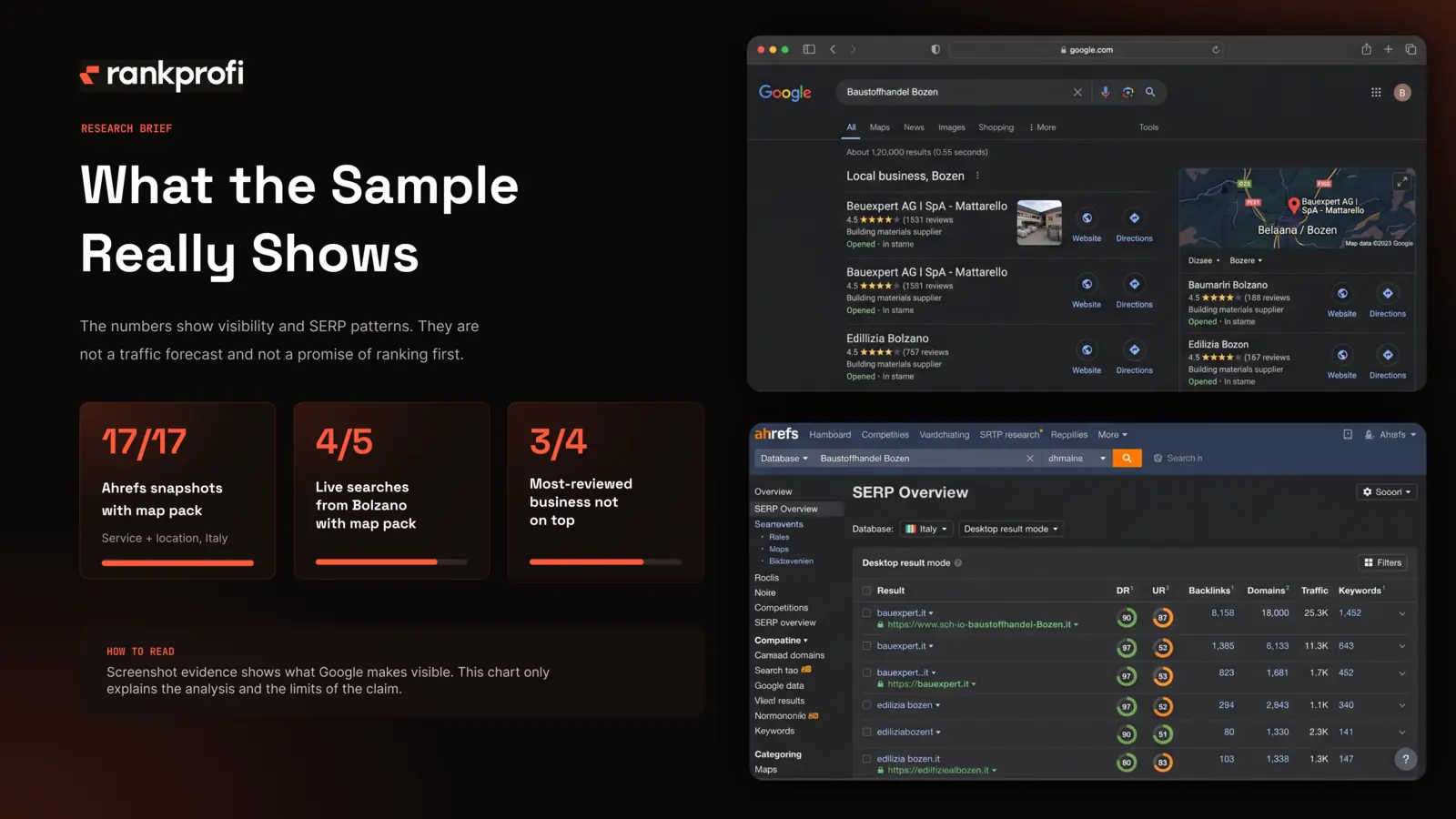
Figure: analysis of the SERP sample from 3 September 2026. The numbers show patterns, not ranking forecasts.
The customer is not searching for your name. They are searching for their problem.
A homeowner in Bozen has a short circuit in the fuse box. He does not know an electrician. He types "Elektriker Bozen" or, depending on his first language, "elettricista bolzano". He is not looking for a business; he is looking for the solution to his problem, in his town, today.
How often that happens can be measured. Ahrefs estimates 200 searches a month in Italy for "elettricista bolzano", 150 for "idraulico bolzano", 100 for "elektriker bozen", 100 for "serramenti bolzano", 60 for "hydrauliker bozen", 60 for "fabbro bolzano", 40 for "imprese edili bolzano", and 30 each for "bauunternehmen südtirol" and "baufirma südtirol" (Ahrefs, as at 3 September 2026, figures confirmed 9 September 2026). These are estimates, not exact figures, and they say nothing about how many of these people end up awarding a job. What they do show is that the demand exists before your business does anything about it.
They show a second thing too: for many of these searches Ahrefs records a map block, which Google calls "local results". Three businesses with rating, category, opening hours and phone number, above the first website. In our sample, 17 service-plus-place searches had an Ahrefs snapshot of the results page, and all 17 contained that block. That is where Google Maps becomes decisive for your business, even if the customer never opens the maps app.
What Google actually shows for "Elektriker Bozen"
We looked, not in a tool but on Google, on 3 September 2026, from Bozen.
Google search "Elektriker Bozen", 3 September 2026, location Bozen
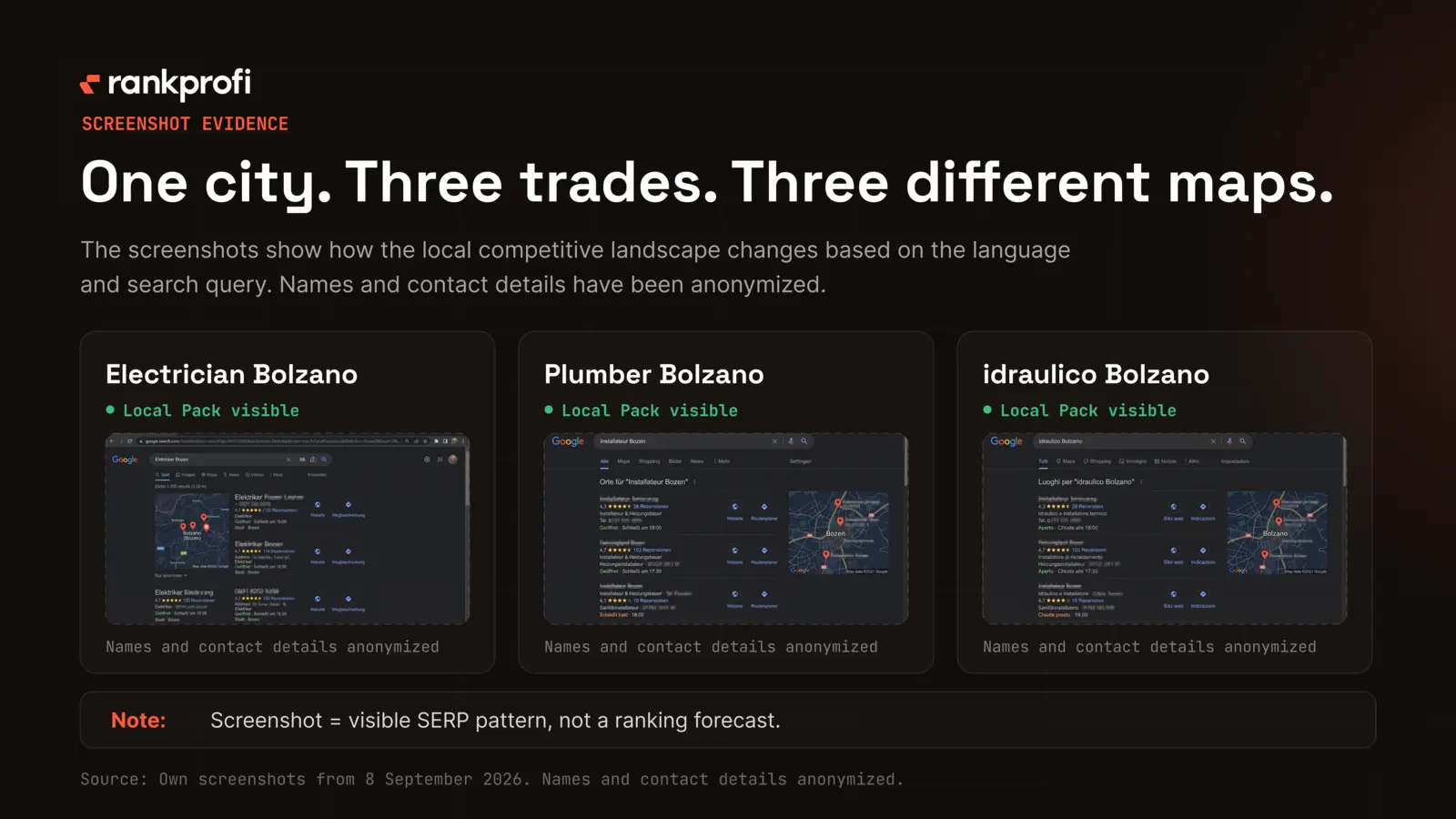
Figure: local Google results for electrician, plumber and idraulico in Bozen. Business names and contact details redacted.
At the very top, a map block with three businesses. In first place a business with 4.8 stars from 264 reviews, whose displayed category is "Elektrofachgeschäft", an electrical shop. What services that business actually offers, the displayed category does not say. In second place an electrician with 5.0 from 32 reviews, in third an electrician with 5.0 from 20 reviews and the note "on-site services not available".
Further down, a second map block with three more electricians: 4.6 from 9 reviews, 4.4 from 9, 5.0 from 7.
Between and below them, the websites: six company sites of electrical businesses from Bozen and the surrounding area, the LVH trade directory, a Facebook page, a jobs portal. According to Ahrefs those company sites have a Domain Rating between 0 and 26. Domain Rating is an Ahrefs metric for a domain's link profile; it says nothing about a business's skill, reputation or size. For this search the figure means: a strong link profile was not a requirement for being on page one.
Source: Google.com, search with location Bozen, language German, 3 September 2026. Domain Ratings: Ahrefs SERP overview, Italy, 3 September 2026. A snapshot, not a permanent state: map blocks change with location, time of day and device.
The map block is no guarantee, however. In our five live searches on 3 September it appeared four times; for "Dachdecker Meran", searched from Bozen, Google showed only organic results, exclusively company sites from the Burggrafenamt. Whether that was down to the smaller municipality, the distance from the search location or the time of day cannot be told from a single search. For your business it means: the map block is the most important place, but the first page below it remains the second, and for some searches it is the only one.
What does this mean for a trade business? Three things. First: the customer sees your business only if it is in one of those two blocks or on the first page below. Second: in first place sat a listing whose category does not name the service being searched for. Why Google shows it there cannot be told from the outside; Google does not disclose the ordering within the map block. Third: the first page below is made up of small businesses' websites with low Domain Rating. For this search, a strong link profile was evidently not a requirement.
That a business with 264 reviews sits ahead of businesses with 32 and 20 sounds like a simple recipe. It is not. In the map block for "Installateur Bozen" on the same day, a business with 26 reviews sat ahead of one with 125. For "idraulico bolzano", a listing with 26 ahead of one with 108. Reviews count, but they do not decide on their own.
Second language, second results page
In South Tyrol some customers search in German and some in Italian. What many businesses do not know: Google does not serve the same page in two languages. It serves two different pages.
Same service, two languages, 3 September 2026
| Search | Businesses in the first map block | Overlap |
|---|---|---|
| "Elektriker Bozen" / "elettricista Bolzano" | 3 + 3 | 1 business in both (in a different position each time) |
| "Installateur Bozen" / "idraulico Bolzano" | 3 + 3 | 1 business in both |
| "Bauunternehmen Südtirol" / "impresa edile Bolzano" (Ahrefs snapshot, two blocks each) | 6 + 6 | 0 businesses in both |
| "Bauunternehmen Südtirol" / "impresa edile Bolzano" (Ahrefs snapshot, two blocks each) | 6 + 6 | 0 businesses in both |
The third row, though, compares more than two languages. "Bauunternehmen Südtirol" queries a region, "impresa edile Bolzano" a city. That no business overlaps there therefore cannot be attributed to language; the two effects cannot be separated in that row. What is cleanly comparable are the two Bozen pairs, and there the overlap is one business in three.
The websites below differ too. In German, company sites and the LVH directory "meinhandwerker" dominate. In Italian, Pagine Gialle (Domain Rating 90), ProntoPro (73), Pagine Bianche (89), Instapro (53) and Edilnet (54) sit ahead of most businesses. The company sites that still make page one in Italian have one thing in common: a page titled "Elettricista a Bolzano" or "Impresa edile Bolzano", not just a home page.
Source: Google.com, location Bozen, 3 September 2026, language German and Italian; Ahrefs SERP overview Italy, 3 September 2026. A sample of three service pairs, not a statement about the whole market.
A business that appears only in German is not "slightly less" visible to the Italian-speaking customer. It is competing in a different contest, against different opponents, and in our sample it mostly did not appear there at all. The same applies in reverse. How large the Italian share of your customers is, you know better than any statistic. That it has to be won separately on Google is what the sample shows.
One more detail from the same search: under "Installateur Bozen", Google suggested "Hydrauliker in der Nähe" and "Hydrauliker Südtirol" as related searches. "Hydrauliker" is the common South Tyrolean word for a plumber; in mainland German usage it is unusual. Ahrefs estimates 150 searches a month for "hydrauliker", 70 for "hydrauliker in der nähe", 60 for "hydrauliker bozen". For "installateur bozen" Ahrefs has no entry at all. Anyone who names their services in their profile and on their website the way a business in Munich would is naming them past a portion of their customers.
What local visibility depends on, according to Google
A great deal gets claimed on this subject. So this article separates three things: what Google says, what we observe in the results, and what we recommend as a result.
Confirmed by Google. The order of local results depends, according to Google, mainly on three factors (Google Business Profile Help, "Improve your local ranking on Google", as at 3 September 2026):
- Relevance: "Relevance is how well a Business Profile matches what someone is searching for."
- Distance: "Distance refers to how far each business is from the customer who's searching."
- Prominence: "Prominence means how well-known a business is."
And one sentence every business should know when it is offered a "guaranteed top-3 placement": "There's no way to request or pay for a better local ranking on Google."
On the same page Google says what a business should do: verify the business, keep address, opening hours, category and attributes complete and current, respond to reviews, add photos. Google says nothing more specific than that.
Observed by us. Listings appear in the map blocks whose displayed category does not name the service searched for: an electrical shop for "Elektriker", an "air conditioning shop" for "Installateur", an energy supplier for "elettricista". Whether something is set wrongly in the individual profile cannot be judged from the outside. Businesses from neighbouring towns rank for the city search. Small websites rank organically when the page title names the service and the place. The business with the most reviews is not always at the top.
Recommended by us. Everything in the sections that follow. It derives from Google's three factors and from the observations, but it is our assessment, not a guarantee.
What a trade business can actually change
This table is the short version of the rest of the article. The column on the right says how solid the connection is, so you know what you can rely on and what you cannot.
| What you set | Which factor | What a trade business actually does | How solid |
|---|---|---|---|
| Primary category | Relevance | The trade you live off, not the shop on the side | Google confirms the category as part of relevance |
| Services in the profile | Relevance | Bathroom renovation, roof renovation, photovoltaics, window replacement, in both languages, in the words used in South Tyrol | Google recommendation (keep the profile complete) |
| Address or service area | Distance | Hide the address if no customer ever comes to the office; set the service area by the places you actually work | Google rule, quoted verbatim |
| Several locations | Distance | One profile per real location with staff, none for places without one | Google rule |
| Reviews | Prominence | Ask after every job, reply to every one, in both languages | Replying is a Google recommendation. "More reviews means a better position" is not confirmed by Google, and not by our sample either |
| Photos | Prominence | Real building sites and the team instead of stock images | Google recommendation, with no quantity given |
| Website with service pages | Relevance, indirectly | One page per core service, naming the service and the catchment area in the title | Our recommendation. Observed for the organic results; whether it affects the map block is not something Google says |
| The same details everywhere | Prominence, indirectly | Write name, address, phone and services the same way on the website, in the profile and in directories | Our assessment, derived from Google's factors, not confirmed by Google |
What this table deliberately leaves out is a ranking by impact. How strongly individual signals count is not disclosed by Google, and any percentage given for it is guesswork.
Figure: Google names relevance, distance and prominence as the central factors for local results. For a trade business that becomes a concrete plan of work.
Category and services: what your business IS, not everything it can do
Relevance starts with the category. Google asks you to choose as few categories as possible and to answer the question "this business IS a…", not "also does…" (guidelines for representing your business, as at 3 September 2026). The primary category is the single most important decision in the whole profile, and the first piece of practical work in SEO and GEO for trade and construction businesses.
For a trade business that means:
- An electrical business with a shop chooses "Electrician" as its primary category if it lives off installation work, and "Electrical supply store" as an additional one. Not the other way round. The reason is the customer's perspective: in the map block the first thing they read is the category, and if the service they want is not in it, they have to guess. How many calls that costs or brings cannot be read from a map block; you can only decide it for your own business.
- A heating and plumbing business chooses between "Plumber" and "HVAC contractor" according to the work it actually wants, not the one that sounds better.
- The services in the profile are the second lever. This is where the words customers use belong: bathroom renovation, rewiring, photovoltaics, heat pump, roof renovation, window replacement. In German and in Italian, if you want both groups of customers. And in South Tyrol: Hydrauliker, not only Installateur.
What Google does not allow, because it misleads customers: putting services or places in the business name. The name in the profile has to be the name on your sign and on your invoice. "Elektro Muster" is correct; "Elektro Muster Elektriker Bozen Notdienst" is a violation that can get the profile suspended.
Address or service area: the decision tradespeople often get wrong
Most trade businesses work where the customer is, not where the office is. Google has a rule for exactly this, and it is unambiguous: "If you don't serve customers at your business address, remove your address from your Business Profile." (Google Business Profile Help, service-area businesses, as at 3 September 2026). Instead you define a service area, by towns, postcodes or regions: "You can have up to 20 service areas." And the boundaries have a limit: "The boundaries of your overall area shouldn't be more than about 2 hours of driving time from where your business is based."
How to decide:
- Workshop, showroom or office with customer visits (joinery with a showroom, window maker with a sample room, electrical business with a shop): show the address. Add a service area as well if you also travel out. Google calls this a hybrid business; both together are allowed.
- Sites only, no customers at the office (many electricians, plumbers, painters, floor layers, roofers): hide the address, set a service area. Your business stays visible in Google Maps, just without a pin on the office.
- Several real locations (a branch in Bruneck and one in Bozen, each with its own staff and customer traffic): one profile per location. Google does not allow more than one profile per location, but it does require one per real location.
That a city address is not a requirement was visible on 3 September under "Installateur Bozen": four of the six businesses in the two map blocks are not based in Bozen but in Mölten, Deutschnofen, Jenesien and Terlan. Whether those profiles use a service area, an address, or both cannot be seen from the outside; another business's profile settings are not public. So the observation says: it is possible. It does not say what makes it possible.
What Google forbids and we never recommend: inventing a branch in order to appear in another town; using an acquaintance's address or a PO box; renting a "virtual office" where nobody ever works; creating a separate profile for every town in the service area. Suggestions like these come up again and again, and every one of them risks the profile that brings the business enquiries today.
Why your website still decides the outcome
Google Maps is not a separate channel running alongside your website. It is the first stop on a path that ends on your website, or breaks off: The map pack is only one of several routes an enquiry can take. Which of them actually belong to your business, and which only run while you keep paying, is what we compare in Marketing for Tradespeople.
Customer searches "Dachdecker Meran" → first page, no map block for this search → company website or Business Profile → the page they land on → references, photos, reviews → call or enquiry.
At every stop the customer can drop out. Where that happens most often in your business is something only your own analytics will show; without measurement it stays a guess. One place where it often stalls, in our experience, is the landing page: the customer arrives with "Dachdecker Meran" and reads "Welcome to Muster GmbH, your partner for quality" instead of "Roof renovation, roofing and sheet-metal work in Meran and the Burggrafenamt, with 30 reference projects".
This is our recommendation, not a Google rule: one page for each core service, naming the service and the service area in the title, with real project photos, references and a direct way to get in touch. The observation behind it: in our sample of five live searches and six Ahrefs snapshots, the company websites on page one had a Domain Rating between 0 and 32. Pages with a Domain Rating of 0, 1 or 2 made it there too, and with exactly those kinds of service pages ("Elettricista a Bolzano", "Impresa edile Bolzano", "Ihr Bauunternehmen in Südtirol"). You do not need a big website for this. You do need a fitting one.
Whether such pages also influence the map block, Google does not say. Google only says that relevance means the profile matches what is being searched for. In our assessment it helps when the profile, the website and third-party listings describe the same services in the same words. We cannot prove that from the data.
Reviews: trust that customers read and Google sees
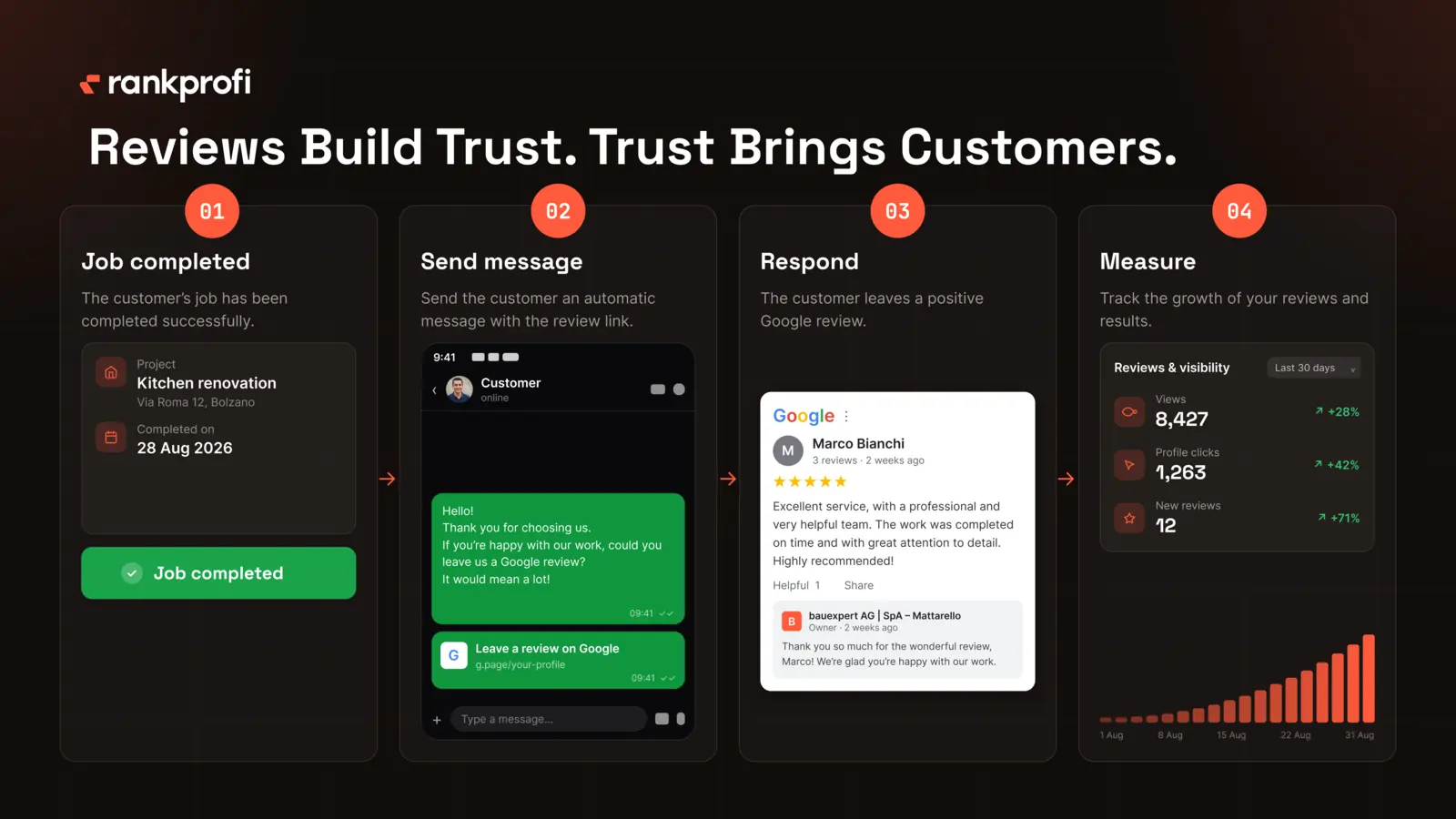
Figure: review process for trade businesses. The focus is a clean request after the job is finished, replies, and measurement.
Three levels, kept apart.
What Google says. "To leave reviews, you can ask customers to visit a Google link or scan a QR code." (Google Business Profile Help, "Get more reviews", as at 3 September 2026). You may not offer anything in return: "Offering incentives, like free or discounted goods or services, in exchange for customers to post reviews, change reviews, or remove negative reviews is considered fake & misleading content and is strictly prohibited." And Google recommends replying to reviews, including critical ones.
That help page says nothing about selectively pre-sorting customers: asking only the satisfied ones for a review and steering the unhappy ones to an internal form. We still do not recommend it, and that is our position, not a Google rule: a body of reviews collected from pre-sorted customers helps the next prospect very little, and it collapses the moment somebody writes unprompted.
What we observe. In the four map blocks in our sample, review counts ranged from 1 to 264. In three of the four blocks, the business at the top was not the one with the most reviews. Reviews are visible and they work on the customer, but "more reviews equals a better position" is confirmed neither by Google nor by our sample.
What we recommend. After every completed job, a short message with the review link, ideally from the fitter who was on site rather than from a general address. Reply to every review within a few days, with a sentence about the actual project. Answer critical reviews calmly; the next customer reads the reply, not just the criticism. And accept and answer reviews in both languages, because the Italian-speaking customer looks for whether anyone replied in Italian.
Mistakes we see in trade businesses
What became visible in our sample of 3 September, and what we keep encountering in our work with businesses in South Tyrol, without names:
- Wrong primary category. The shop is the primary category and the trade is secondary. Result: visible for the wrong search.
- Address shown even though no customer ever comes. It breaks Google's rule and puts the pin on a private house.
- Two profiles for one business. An old one that was never deleted and a new one. Reviews split between them, Google shows sometimes one and sometimes the other. What that looks like was visible on 3 September for "idraulico bolzano": two listings with the same business name in the same map block, one with 26 and one with 108 reviews. Whether that is a duplicate or two genuine locations cannot be decided from the outside. That is exactly the point: when it is not unambiguous, the trust splits too.
- Services in German only. The Italian-speaking customer finds a profile with no service list in their language.
- Business name with add-ons. "Muster Elektro Bozen Notdienst 24h" instead of "Muster Elektro".
- A website with no service pages. A home page, an "about us", a contact form. Nothing for Google to classify a business by for "Dachdecker Meran".
- No measurement. The business does not know whether enquiries come from Google, from Maps, from a referral or from the van. The next section is about that.
How to measure whether Google Maps brings enquiries
The most important rule first: never jump from "views" to "revenue". Every step is measured on its own, otherwise you will talk yourself into successes that are not there.
Step 1: visibility. In your Business Profile under "Performance", Google shows which searches your profile appeared for and how many people viewed it. Google counts individual users, not views: "The metric counts the number of unique visitors who viewed your profile." And: "A person can only be counted once a day. We don't count multiple visits on the same day." (Google Business Profile Help, "Performance and insights", as at 3 September 2026). Look at the search terms: does it say "Elektriker Bozen", or only your company name? That is the question this whole article is about.
Step 2: interaction. The same menu shows calls, direction requests, website clicks and messages. Those are actions, not jobs.
Step 3: website visit. So that you can tell in Google Analytics or another tool which visitors come from the profile, add a parameter to the website link in your profile, for example ?utm_source=google&utm_medium=organic&utm_campaign=business-profile. This is our recommendation, not a Google requirement; Google shows you the clicks either way, but your website statistics will then attribute them to Google without distinguishing between the profile and ordinary search.
Step 4: enquiry. A contact form with a required field "How did you find us?", or a note in the office phone log with the same question. Without this step you will still not know a year from now what the map block brought you.
Step 5: job won. Which enquiries turned into jobs, and at what value. That is in your job management system, not in Google.
An example from our own work: Bauexpert, a building-materials retailer with 16 locations in South Tyrol and Trentino
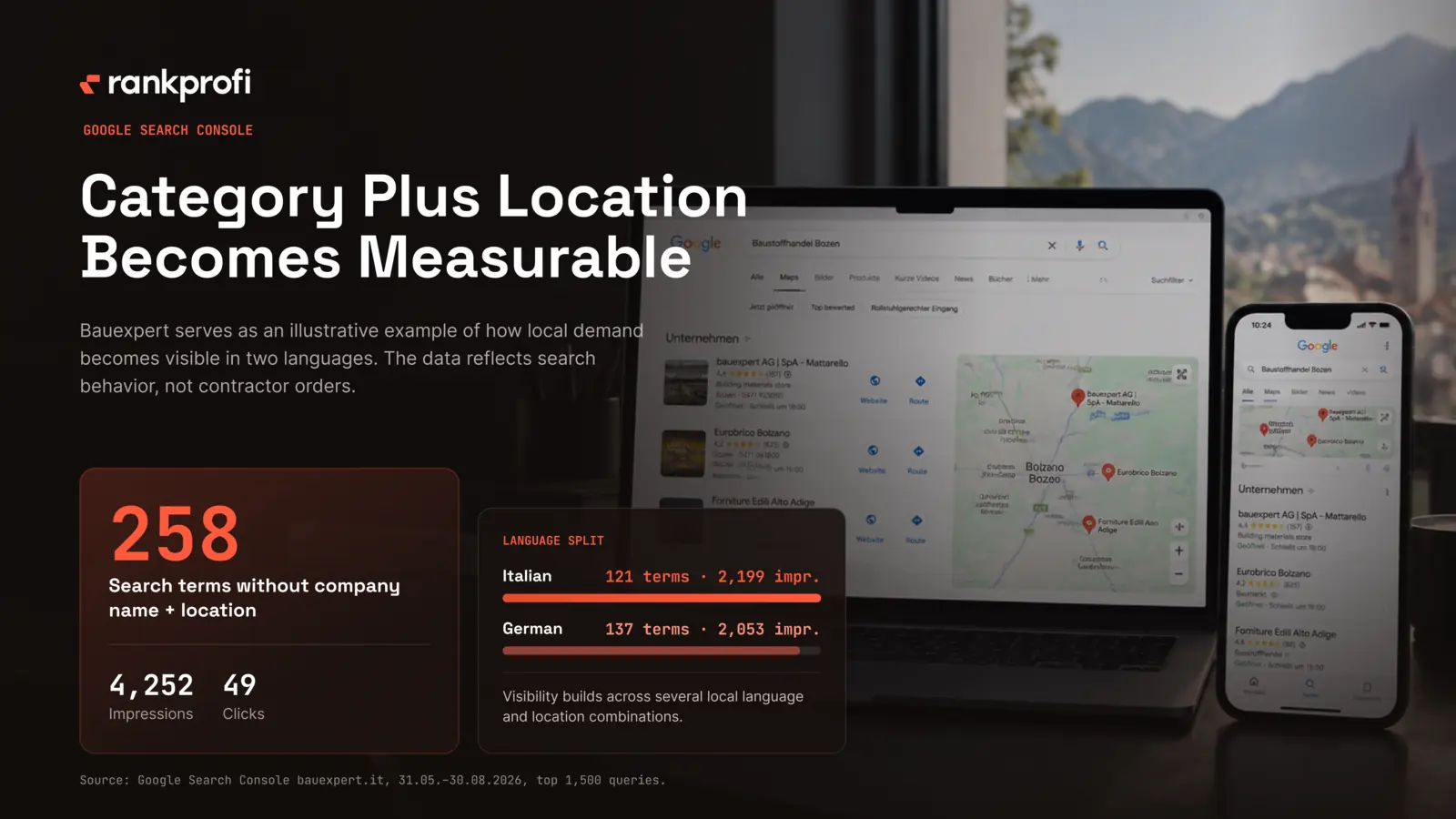
Figure: Google Search Console analysis for Bauexpert. Local category-plus-place searches appear in German and Italian.
Bauexpert, a building-materials and builders' merchant business with 16 locations in South Tyrol and Trentino, appeared between 31 May and 30 August 2026, in the top 1,500 search queries analysed, for 258 searches without the company name that contained a place: 4,252 impressions, 49 clicks. In Italian ("ferramenta rovereto" 660 impressions, "materiali edili trento" 123, "materiali edili bolzano" 79) and in German ("baumarkt brixen" 183, "baumarkt bozen" 165, "baumarkt bruneck" 115, "dachdecker südtirol" 67) in roughly equal measure: 121 Italian search terms with 2,199 impressions, 137 German ones with 2,053.
Positions were mostly between 4 and 11. Visible, but rarely in the top three, and the 49 clicks show what visibility in those positions is worth.
Source: Google Search Console bauexpert.it, 31 May to 30 August 2026, top 1,500 queries, search type Web. Account managed by RankProfi. Language attribution estimated manually, not a Google breakdown. A builders' merchant is not a trade business; the figures document "category plus place" search behaviour in both languages, not trade jobs won.
Two limits belong with these figures. First, they come from Google Search Console and describe web search, not the Business Profile and not Google Maps. They say nothing about profile views, calls or direction requests, and enquiries or jobs cannot be read from them at all. Second, Bauexpert is a building-materials and builders' merchant with 16 locations, not a trade business.
What the figures do show is the "category plus place" search pattern in both languages, at a company in the construction sector. Whether an electrical business with one location sees the same proportions cannot be inferred from this.
A 30-day plan for a trade business
No promise of first place. A plan that leaves you, in a month, knowing where you stand and having fixed the most important mistakes.
Week 1: look. Search Google for your three most important services plus your town, in German and in Italian, once from the office and once from your phone while out. Note who is in the map block, with which category and how many reviews. Note whether you appear. Open "Performance" in your profile and write down the figures for views, calls, direction requests and website clicks over the last six months. That is your baseline.
Week 2: profile. Check the primary category and correct it if necessary. Build the service list in both languages, using customers' words. Show or hide the address according to the rule above, and set the service area. Clean up the business name. Look for a duplicate profile and have it merged. Ten recent photos of real projects, no stock images.
Week 3: website. One page per core service, naming the service and the service area in the title, with reference photos, three sentences on how the work runs, a phone number and a form. In German and in Italian if you want both markets. Add the tracking parameter to the website link in your profile. The same services, the same words as in the profile.
Week 4: reviews and measurement. Create the review link and put it in the closing message to every customer. Reply to all outstanding reviews. Add "How did you find us?" to the form and to the phone log. In 90 days, write down the week-1 figures again and compare: first search terms and views, then calls and clicks, then enquiries. Separately.
And what about AI?
A growing share of customers ask ChatGPT, Perplexity or Google's AI mode: "Which electrician in Bozen would you recommend?" Google itself now answers many searches with an AI answer before the normal results; how AI Overviews rewrite the first page of Google work is a separate article. We do not yet have solid figures on which South Tyrolean trade businesses get named in those answers; a measurement is in preparation, and how we measure AI visibility is written up in the open. What can be said: clear, consistent business information and solid mentions by third parties can strengthen the signals AI systems have available about a business. Which factors actually lead to a business being named is not disclosed by the providers. The work described in this article certainly does no harm there: a clean profile, unambiguous services, a website that says the same thing.
Do it yourself or hire an agency? Five questions to ask
Weeks 1, 2 and 4 of the plan you can do yourself. They cost time, not money. It gets harder with a website in two languages, with the question of which services are worth pursuing in which towns, and with ongoing measurement all the way to the enquiry. If you bring somebody in for that, ask these five questions:
- Will you show me search data from South Tyrol, in German and in Italian, not from Germany?
- What will we measure after 90 days to know whether it works: enquiries, not views?
- How do you find out whether my business appears in AI answers?
- What exactly will you do with my Google profile, my locations and my reviews, and what will you refuse to do?
- What stays with me if we end the collaboration: content, access, data?
Anyone who answers question 4 by proposing secondary profiles, bought reviews or a business name with a town appended has not read Google's guidelines, or is ignoring them.
RankProfi is an SEO and GEO agency based in South Tyrol. We work for companies in construction, interior fit-out and hospitality, in German, Italian and English, with search data from South Tyrol and Trentino. What SEO and GEO for trade and construction businesses covers in practice is on its own page; how we build local visibility is too. The profile-completion steps this article deliberately skips are in our checklist for the Google Business Profile.
What ongoing support costs for your business depends on competition, the number of locations, the condition of the website and how much German and Italian coverage is needed, among other things. We name the range after the free Google and AI visibility analysis.
Free Google and AI visibility analysis for your business
We check whether your business appears in the relevant local searches in your service area, how your Google Business Profile is positioned against the businesses in the map block, where competitors are more visible than you in German or Italian, and whether there is demand for your services that nobody is picking up today.
Request your free Google & AI visibility analysis
Frequently asked questions
Why is my Business Profile not visible on Google?
The most common reasons in our experience: the profile is not verified; the primary category does not match the search; the address is shown when a service area was meant, or the other way round; there is a second profile; or the customer is searching in the region's other language, in which your profile names no services. Check those five points before you think about reviews.
Do I need a separate profile for every town in my service area?
No. Google allows one profile per real location with staff, not one per town you work in. The service area covers your job sites: up to 20 towns or regions within roughly two hours' drive. Extra profiles for places without a location breach the guidelines.
Do I have to show my address?
Only if customers visit you there. If you exclusively travel to customers, Google requires you to remove the address from the profile and give a service area instead. You stay visible either way.
What is Installateur in Italian, and why does South Tyrolean Google show "Hydrauliker"?
In Italian, "idraulico"; for heating, usually "termoidraulico". In South Tyrol many German-speaking customers say "Hydrauliker", and they search that way too: Ahrefs estimates 150 searches a month for "hydrauliker" and 60 for "hydrauliker bozen". For "installateur bozen" there is no Ahrefs entry. Use both words in your profile and on your website.
Do more reviews automatically mean a better place on the map?
Google does not confirm that, and neither does our sample from 3 September 2026: in three of four map blocks, the business at the top was not the one with the most reviews. Reviews influence whether the customer calls, and Google recommends replying to them. As a sole recipe for the ordering, they do not work.
What does it cost to have the Google Business Profile optimised?
The profile itself is free, and the groundwork in the 30-day plan you can do yourself. If a business has its profile, bilingual service pages, review process and measurement looked after on an ongoing basis, we name the range after the free Google and AI visibility analysis. Offers of a "guaranteed top-3 placement" should be turned down; Google writes itself that a better local ranking cannot be bought.
Data as at 3 September 2026.
Frequently asked questions
Through the signals Google uses to build the order, not through a purchase. Google names relevance, distance and prominence. In practice that means a fitting primary category, services in both local languages, a correct address or service area, reviews that keep coming in and get answered, and your own service pages that name the service and the place.
Common causes are an unverified profile, a primary category that does not match the search, a wrong choice between address and service area, a second profile, or missing services in the customer's language.
No. Google allows one profile per real location with staff, not one per town you work in. Extra profiles for places without a real location breach the guidelines.
Only if customers visit you there. If you exclusively travel to customers, Google requires you to remove the address from the profile and give a service area instead.
In Italian it is “idraulico”, and for heating usually “termoidraulico”. In South Tyrol “Hydrauliker” is a common German search term. Your profile and website should therefore cover the words both customer groups actually use.
No. Google confirms no direct mechanism. Reviews build trust and Google recommends replying to them, but in the sample we examined the business with the most reviews was not always at the top.
The profile itself is free and a business can do the groundwork in the 30-day plan itself. What ongoing support costs depends on competition, the number of locations, the state of the website and how much German and Italian coverage is needed. We name the range after the free Google and AI visibility analysis.
Sources
- Relevance, distance and prominence as factors in local results; a local ranking cannot be bought.Google Business Profile Help, Improve your local ranking on Google · 2026-09-10
- Rules for address, service area, the maximum number of areas and the distance limit.Google Business Profile Help, Service-area businesses · 2026-09-10
- Asking for reviews, the review link or QR code, and incentives that are not permitted.Google Business Profile Help, Get more reviews · 2026-09-10
- Definitions of the performance metrics for the Google Business Profile.Google Business Profile Help, Performance and insights · 2026-09-10